
Showing posts with label Inventions. Show all posts
Showing posts with label Inventions. Show all posts
The Wheel

Lesser Known Thomas Edison's Inventions
Thomas Edison is mostly famous for his inventions of the
light bulb and phonograph. However, he created many more things that we still
use today. For example, he made the early version of fruit preservation. He
came about this discovery when he was working with light bulbs and glass vacuum
tubes. To preserve the food, fruit or vegetables (etc.) was put in a glass jar
and then all the air was sucked out by another glass piece so they lasted
longer. He applied for his patent in 1881. This way to keep food fresh led the
way to today’s machines that can be found in any household as vacuum sealers.
Linnea
***
One invention that Thomas Edison was a bit less well known
for was the magnetic ore separator. The idea was to use magnets to separate
iron ore from unfeasible lower grade ores. This meant that uninhibited mines
could be lucrative through the removal of iron from sand at the sites. At that
time, iron ore prices had risen to extraordinary heights. While Thomas Edison’s
lab was preoccupied with evolving a magnetic ore separator and putting it to
use; he acquired rights to 145 abandoned mines and set up a pilot project at
the Ogden mine in N.J. He poured money into the development, progressively
selling most of his interest in the General Electric Company to pay for his
work, but the engineering problems were never worked out and the price of iron
ore fell which lead him to abandon the separator.
Maria
***
One invention that I was surprised that Thomas Edison
invented was the synthetic rubber that we got to see in the museum’s Chemistry
Lab. Edison worked with many different types of plants to create rubber. He
finally settled on goldenrod to make the best product. I was surprised because
of people, including myself, usually, associate Edison strictly with inventions
such as the light-bulb. It was interesting to learn that Edison also
experimented with plants and their uses. It showed me that he was a very
versatile and innovative inventor.
Kristin
Thomas Edison Laboratories - Voice Recording


One great invention by Thomas Edison is the phonograph which records your voice and it plays it back. When speaking into the receiver the sound vibration of the voice would cause a needle to create indentations on a drum wrapped with tin foil. The first recorded message was of Thomas Edison speaking "Mary had a little lamb". He showed it to others and from that he produced other amazing things. Like inventing things that help people play music from their homes.
Emelyn
The Black Maria
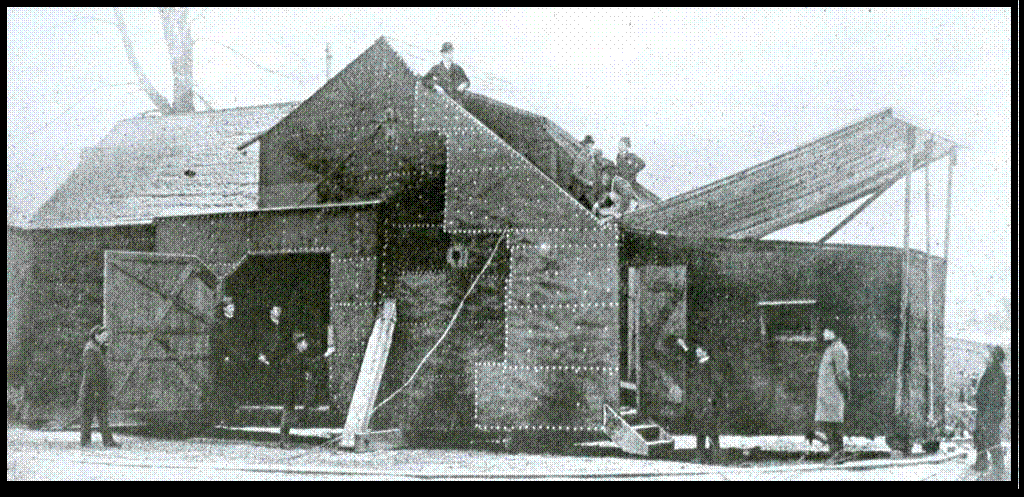
The Black Maria was Thomas Edison’s movie production studio. Built in 1893, it is known as the world’s first movie production studio. Films were shot using the kinematograph, which was the most state if the art, stop-and-go, filming device of its time. The Black Maria had a huge window on its ceiling in order to let sunlight into the studio because the films in this time period required an immense amount of light in order to be filmed properly. Due to the times, only silent films were filmed, but this studio was still revolutionary in the making of the modern world's entertainment.
Fernando
***
Thomas Edison constructed the first movie studio in West Orange, New Jersey. This studio or Kinetographic Theater, as it was formally called, was made out of wood, tar paper, and a roof that opened up to the sun. It was also built on a turntable to allow movement towards sunlight during the course of the day. This studio was coined the Black Maria because its eccentric appearance resembled a police wagon. The Black Maria was a venue in which many short films or motion pictures were recorded. Blacksmith Scene, Fred Ott’s Sneeze, and Sioux Ghost Dance were a few of these films. Later, in 1903, the Black Maria was torn down after Edison built a glass-enclosed rooftop studio in New York City. A replica constructed in 1954, remains in Thomas Edison’s National Historical Park.
Anette
Alexander Hamilton and the establishment of industry

History proves that a connection of science and business fuels innovation, development, thereby strengthens economy. Alexander Hamilton (1755 - 1804), the United States first Secretary of Treasury, was a visionary politician who greatly supported the establishment of industry in the States.
The city of Paterson was one of the first industrial cities in the United States. The manufacturers were using the energy of the Great Falls. Before electrical transmission lines were invented, transporting energy was a challenging task. How would one transport the energy of the waterfalls to the factories without electricity? The answer to that question required an open mind, creativity, courage, broad knowledge, the ability to convince others to accept an innovative idea, and perseverance. The combination of all these qualities was a foundation of the industrialization of the city of Paterson, and the phenomenal growth of the economy.
Alexander Hamilton statue, Great Falls National Historical Park
(photo by Anthony)
Subscribe to:
Comments (Atom)